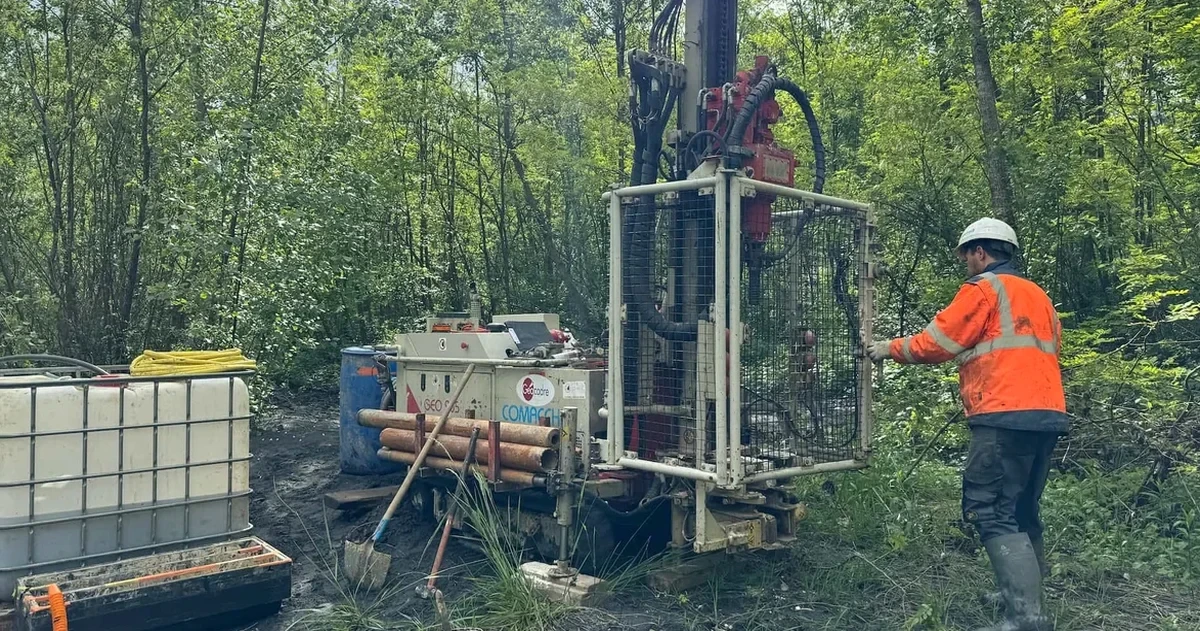
A drill rig extracting Shelby tubes from a site near the Menomonee Valley tells a story that only a soil mechanics study can interpret. The split-spoon sampler coming up with gray, silty clay signals the presence of the lacustrine deposits that underlie much of downtown Milwaukee. Our laboratory processes these samples through a sequence of index and strength tests, correlating moisture content, Atterberg limits and unconfined compressive strength to produce a geotechnical profile that the structural engineer can trust. We run the triaxial cell when the project demands it, and the consolidation frame when settlement is the controlling factor on compressible ground. In a city built on fill, marshland and glacial drift, the difference between a confident foundation design and a costly surprise comes down to how thoroughly the soil mechanics study captures the real behavior of the subsurface.
In Milwaukee, the most expensive soil parameter is the one you didn't test: undrained shear strength of the organic silt layer.
Local geotechnical context
What we keep seeing on Milwaukee projects is a disconnect between the assumed bearing stratum and what the fill actually sits on. The upper five to ten feet across much of the near-downtown corridor is urban fill: brick fragments, cinders, wood debris and reworked native soil, placed without compaction control during the late 19th and early 20th centuries. A soil mechanics study that stops at the fill layer without penetrating into the natural deposit beneath it leaves the designer blind to differential settlement potential. We have encountered cases where a six-foot layer of undocumented organic silt was sandwiched between fill and competent till, and the only reason it was caught was because the lab ran a loss-on-ignition test after the field log noted a faint hydrogen-sulfide odor. When the structural loads are heavy or the tolerances are tight, missing that intermediate weak layer can drive post-construction settlement into the inches, and the repair costs multiply fast.
Quick answers
What is the typical cost range for a soil mechanics study in Milwaukee?
The cost depends on the number of borings, the sampling interval and the laboratory tests requested. For a typical single-family residential or light commercial project in the Milwaukee area, the soil mechanics study ranges from US$2.690 to US$5.620. The lower end covers index testing and unconfined compression on a few samples; the upper end includes triaxial, consolidation and a full interpretive report when the site has challenging fill or organic layers.
How deep should the borings go for a soil mechanics study in Milwaukee?
That depends on the foundation type and the stratigraphy, but as a rule of thumb we extend borings at least 20 to 30 feet into competent natural material below the base of the foundation influence zone. In Milwaukee, where urban fill and organic silt can reach depths of 10 to 15 feet, getting into the underlying glacial till or dolomite is essential to capture the bearing stratum and assess settlement of the weaker layers above it.
Is a soil mechanics study required by the City of Milwaukee for a building permit?
The City of Milwaukee Department of Neighborhood activities follows the IBC, which requires a geotechnical investigation for most structures unless the building official determines that the foundation loads are low enough to waive it. In practice, any commercial, multi-family or industrial project in the city will need a soil mechanics study, and we coordinate directly with the design team to ensure the report meets the plan review requirements the first time.
What laboratory tests are most important for the clay soils common in Milwaukee?
For the lacustrine clays and glacial till that dominate the Milwaukee subsurface, the combination of Atterberg limits, unconfined compression and one-dimensional consolidation gives the essential picture. The Atterbergs tell you how sensitive the clay is to moisture changes, the unconfined test gives a quick undrained shear strength, and the consolidation test provides the compression index and pre-consolidation pressure that control settlement calculations. When the project involves deep excavation or sloping ground, we add consolidated-undrained triaxial testing to get effective stress parameters.