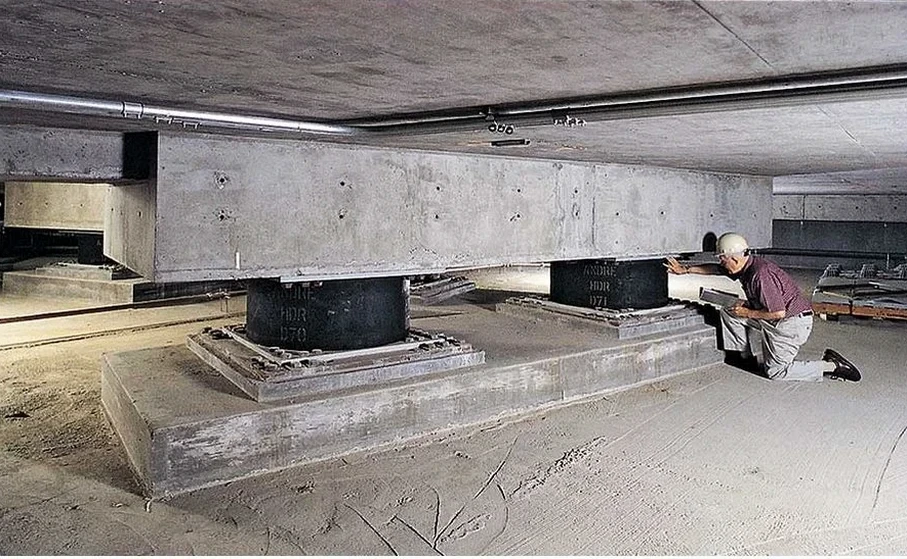
Milwaukee's architectural fabric, from its 19th-century Cream City brick warehouses in the Historic Third Ward to the modern high-rises along the Lake Michigan shoreline, reflects a city that has continuously rebuilt and adapted. This layered urban development, however, often conceals a complex subsurface of glacial till, lacustrine clays, and fill that demands more than conventional seismic detailing. For critical facilities and essential buildings, we design base isolation seismic systems that decouple the superstructure from ground motion, allowing the building to move independently during an earthquake. The approach is sophisticated but the goal is simple: keep a hospital operational or a data center intact when the New Madrid or Wabash Valley seismic zones transmit energy across the Midwest. Milwaukee sits at approximately 43.0386° N, where the deep soil deposits can amplify long-period shaking that base isolation is specifically engineered to address. A thorough seismic microzonation study often precedes our isolator design to map the site-specific spectral response before we specify elastomeric or sliding bearings.
A properly base-isolated building in Milwaukee can reduce inter-story drift by over 70% during a Wabash Valley event, preserving both structural integrity and post-earthquake functionality.
Local geotechnical context
Milwaukee County sits at an average elevation of 617 feet above sea level, but the seismic hazard here is not driven by topography—it's driven by the deep, ancient faults of the Wabash Valley Seismic Zone, capable of producing magnitude 7.0+ events that propagate long-period energy efficiently through the sedimentary basin. A building with a fixed-base design on 80 feet of compressible soil can knowledge resonance that amplifies drift to failure levels during such an event, while a properly base-isolated structure reduces inter-story drift by 60 to 75 percent. The risk is compounded by Milwaukee's aging building stock: unreinforced masonry structures built before modern codes lack ductility and rely entirely on the isolation system to prevent collapse. We model site-specific spectra using probabilistic seismic hazard analysis, not just the generic maps, to capture the contribution of both the New Madrid and local source zones. The isolation system must also function at the extreme cold temperatures Milwaukee experiences in January, where elastomeric bearings can stiffen, a factor we account for in our low-temperature property testing program.
Quick answers
What types of buildings in Milwaukee require base isolation?
Base isolation is typically reserved for Risk Category IV structures—hospitals, fire stations, emergency operations centers—and essential facilities that must remain operational after a major earthquake. In Milwaukee, we also see it applied to historic preservation projects, such as retrofitting unreinforced masonry landmarks, and to data centers and laboratories that house vibration-sensitive equipment. The decision is driven by a performance-based analysis comparing life-cycle costs and post-earthquake functionality requirements, not by a prescriptive code trigger.
How does Milwaukee's soil profile affect base isolation performance?
Milwaukee is underlain by glacial and post-glacial deposits that can amplify long-period seismic waves—the same period range where isolated structures operate. Soft clay layers in the Menomonee and Kinnickinnic River valleys can lengthen site period, which we must account for during ground motion selection and scaling. We perform site-specific response analysis using deep shear wave velocity profiles (often from MASW or downhole testing) to ensure the isolation period avoids resonance with the soil column. The depth to bedrock varies significantly across the county, from less than 50 feet near the lakefront to over 200 feet in the western suburbs, so each site demands its own dynamic model.
What is the approximate cost of base isolation design for a Milwaukee project?
The design and analysis phase for a base isolation system typically ranges from US$3,690 to US$8,460, depending on the complexity of the structure, the number of ground motion pairs required, and the extent of peer review. This covers nonlinear time-history modeling, isolator specification, prototype test plan development, and construction document preparation. The cost of the isolation hardware (bearings) and installation is separate and varies with the building size and number of isolators.