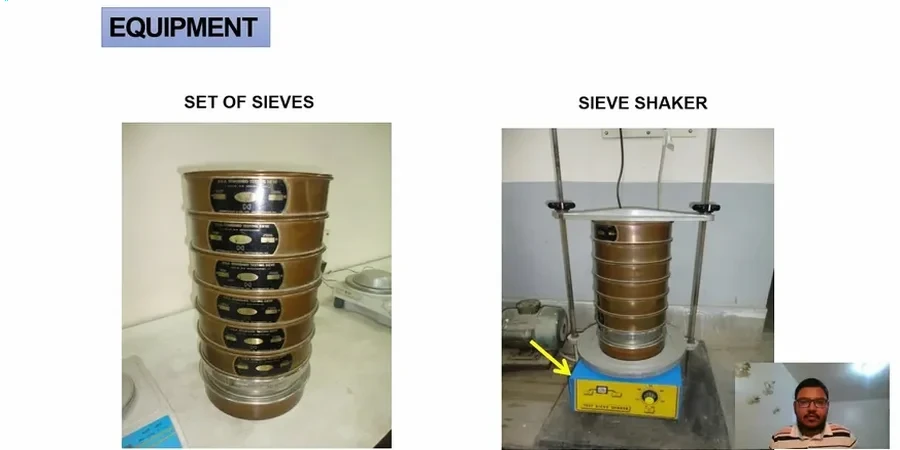
A contractor working on a warehouse expansion near the Menomonee River Valley encountered a layer of what looked like uniform sand at first glance. When the excavation reached 9 feet, the material shifted to a sticky, gray clay that held water and complicated the footing inspection. The project geotechnical engineer requested a full grain size analysis—sieve stack plus hydrometer—to confirm whether the soil profile matched the borings, because the original report had classified it as SM-SC but the field behavior suggested a higher fines content than expected. That kind of discrepancy, where glacial outwash meets post-glacial lacustrine deposits in the Milwaukee Formation, is not unusual in this part of Wisconsin. A combined sieve and hydrometer test, run under ASTM D6913 and D7928 protocols, resolves the ambiguity by quantifying the complete particle-size distribution from gravel down to the colloidal clay fraction, which is exactly what the city requires when bearing capacity or drainage assumptions are on the line. When the lab reported 42 percent passing the No. 200 sieve with a clay fraction of 18 percent, the design team adjusted the subgrade prep and avoided a costly delay.
A visual classification in Milwaukee's glacial soils misses the silt fraction more often than not—the hydrometer picks up what the field log leaves out.
Local geotechnical context
Milwaukee's glacial stratigraphy includes a persistent layer of lacustrine clay and silt that settled in proglacial Lake Michigan roughly 12,000 years ago, and this deposit shows up in geotechnical reports across the East Side, Bay View, and the Third Ward. The clay fraction in these soils rarely exceeds 25 percent, but when it does, the material transitions from a low-plasticity silt to a lean clay that can retain pore pressure for weeks after a heavy rain. A grain size analysis that stops at the No. 200 sieve misses the entire clay-versus-silt distinction, and that omission has led to overestimation of drained shear strength in more than one Milwaukee excavation where the contractor expected sandy silt and got something closer to a CL. The hydrometer curve is the only direct measurement of the 2-micron fraction, and it is the basis for applying empirical correlations like those from Chapuis (2004) to estimate saturated hydraulic conductivity—a parameter that controls dewatering system design on sites within half a mile of Lake Michigan. Without that data, the risk runs from undersized sump pumps to slope instability in temporary cuts.
Quick answers
How much does a grain size analysis with hydrometer cost in the Milwaukee area?
A combined sieve and hydrometer analysis typically ranges from US$90 to US$210 per sample, depending on whether you need the full ASTM D6913 + D7928 suite or just the fines portion. The price includes the hydrometer calibration check, dispersant optimization, and the final particle-size distribution curve with USCS classification. If you bring in four or more samples from the same project, we can often apply a volume discount.
What is the typical turnaround time for a hydrometer test at your Milwaukee lab?
The standard turnaround is two working days from sample receipt to the final gradation report. The hydrometer portion itself requires a minimum 24-hour sedimentation period to capture the clay fraction accurately, and we run the sieve stack in parallel so the combined curve is ready the following afternoon. Expedited same-day hydrometer results are possible if the sample arrives before 9 AM and only the fines curve is needed.
Why does Milwaukee's glacial till require a hydrometer when the field log says sandy silt?
The reddish-brown till that covers much of Milwaukee County contains a matrix of dolomite flour and clay-sized particles that adhere to the sand grains and are nearly impossible to detect by feel alone. A field log will often call it silty sand or sandy silt, but the hydrometer frequently reveals 15 to 25 percent clay content, which is enough to change the USCS symbol and affect the assumed drained friction angle. The hydrometer is the only direct method to quantify that fraction.
Which ASTM standard do you use for the hydrometer analysis, and how do you handle the temperature correction?
We follow ASTM D7928, which is the current standard for sedimentation analysis of fine-grained soils using a 152H hydrometer. The test is run in a constant-temperature water bath set to 20 °C, and we apply the meniscus and temperature corrections specified in the standard. For Milwaukee soils with measurable calcium carbonate content, we also run a dispersant check with sodium hexametaphosphate to confirm that the clay platelets are fully separated before the sedimentation readings begin.