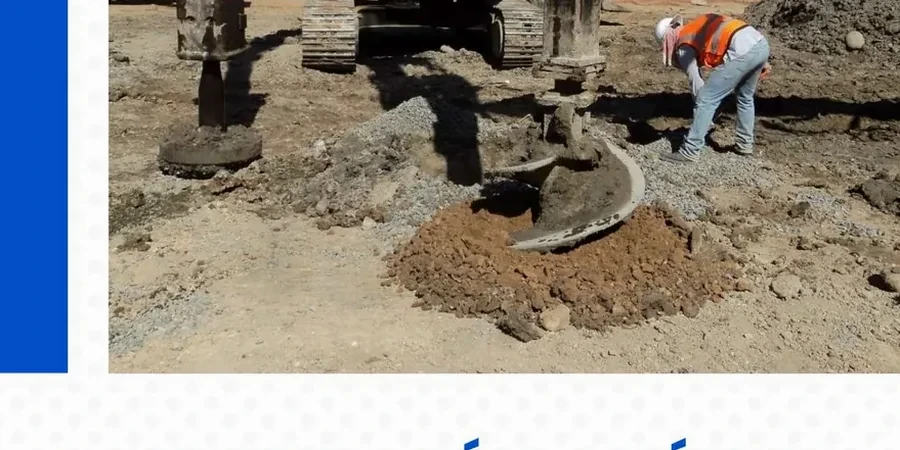
A recent mixed-use development near the mouth of the Menomonee River ran into trouble the moment the excavator bucket hit saturated gray clay at just 6 feet down. The structural loads from the planned five-story steel frame were simply too much for the native organic silts that blanket much of downtown Milwaukee. That is precisely where stone column design becomes the difference between a feasible project and an abandoned foundation concept. Our engineering team has refined the installation parameters and aggregate specifications needed to transfer structural loads through these weak near-surface layers, bypassing the compressible zone entirely and reaching the denser glacial till below. The approach relies on vibro-replacement techniques that densify the surrounding matrix while creating stiff, vertical inclusions of well-graded stone that drain excess pore pressure during consolidation. For sites with marginal bearing capacity, we often integrate findings from a CPT test to map subsurface variability before finalizing the column grid layout.
A correctly sized stone column grid transforms Milwaukee's post-glacial clays into a drained, dense composite capable of supporting structural mats and conventional footings.
Our approach and scope
In Milwaukee, we frequently observe that the natural water content in the Estuarine Clay unit exceeds its liquid limit, which introduces a degree of sensitivity that standard foundation solutions cannot accommodate. A well-designed stone column array addresses this by providing radial drainage paths that accelerate primary consolidation from years to weeks, effectively eliminating long-term settlement before structural framing begins. Key technical aspects we control during design include the area replacement ratio, column diameter typically ranging from 2.5 to 4 feet, and the gradation of the imported stone fill to resist clogging from the fine-grained native matrix. We also verify that the undrained shear strength of the surrounding soil is above the 15 to 20 kPa threshold required for effective lateral confinement during column installation. The design process incorporates site-specific seismic demands per ASCE 7, particularly considering the long-period amplification expected in the deep soil profiles along the Lake Michigan shoreline, and evaluates the composite shear strength of the treated ground to satisfy bearing capacity and global stability requirements under the governing IBC load combinations.
Local geotechnical context
The bottom-feed vibrator is the workhorse on Milwaukee sites where soft ground extends deeper than 25 feet. Its 130-horsepower power pack drives an eccentric weight inside a cylindrical probe, fluidizing the soil with compressed air while stone is fed through a tremie pipe directly to the tip. The risk most project owners underestimate is the potential for excessive lateral displacement toward adjacent utilities or basement walls if the installation sequence is done incorrectly. Milwaukee's old Third Ward and Walker's Point neighborhoods are laced with century-old brick sewers and shallow gas lines that do not tolerate ground heave. We mitigate this by specifying an inward-to-outward installation sequence, pre-drilling a pilot hole through any fill layer containing demolition debris, and maintaining continuous real-time monitoring of amperage and stone consumption at each column location. Without these controls, a column installed with inadequate confinement can bulb outward uncontrollably, wasting aggregate and failing to achieve the design stiffness.
Quick answers
How much does a stone column design and installation program typically cost in Milwaukee?
For a typical commercial building footprint in Milwaukee, the engineering design and full-scale installation of stone columns generally falls between US$1,290 and US$5,190, depending on the treatment depth, column spacing, and total area. Deeper treatment beyond 40 feet or sites requiring a high area replacement ratio above 25% will trend toward the upper end of that range due to the increased stone volume and installation time. We offer a firm design fee and can solicit competitive installation bids from qualified ground improvement contractors in the region.
Will the vibration from stone column installation damage my neighboring building?
The vibratory energy decays rapidly with distance, but we take adjacent structures seriously. Before installation begins, we evaluate the peak particle velocity (PPV) threshold for nearby buildings and utilities and can switch to a bottom-feed method with lower vibration amplitude or adjust the installation sequence to keep the vibrator further from sensitive structures. For sites immediately adjacent to historic unreinforced masonry in neighborhoods like Brewers Hill, we typically specify pre-construction condition surveys and install vibration monitoring points at the property line.
What soil conditions in Milwaukee make stone columns a better choice than deep foundations?
Stone columns are particularly well-suited to the thick, soft lacustrine clays and organic silts deposited in the Milwaukee River and Menomonee River valleys during glacial retreat. When the undrained shear strength is above roughly 300 psf and the soft zone extends beyond 15 feet deep, stone columns can often support spread footings or a mat foundation at a lower cost and faster schedule than driving piles to the underlying till. They also offer the added benefit of accelerating drainage and reducing liquefaction potential in the upper 30 feet, which is a concern along the lakefront on fill over natural deposits.
Do you provide stamped construction drawings for Milwaukee building permit applications?
Yes, our design deliverables include a full drawing set stamped by a Professional Engineer licensed in Wisconsin. The package contains the column layout plan, typical cross-sections showing the treatment depth relative to the bearing stratum, aggregate specification, installation sequence notes, and the testing requirements for the quality assurance program. This documentation satisfies the special inspection and ground improvement submittal requirements under IBC Chapter 18 as enforced by the City of Milwaukee Department of Neighborhood activities.