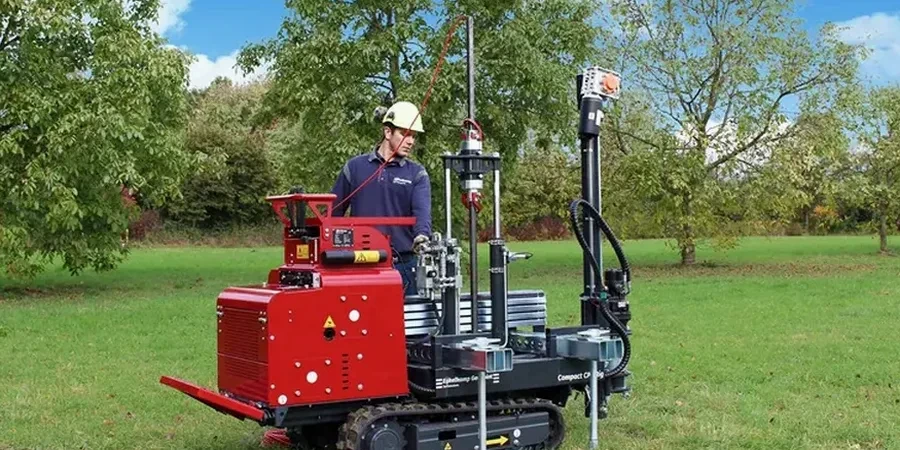
Milwaukee's subsurface is a direct record of its industrial and geological past, where the last glacial advance left a complex sequence of tills, lake sediments, and outwash that varies dramatically between the Menomonee Valley and the uplands west of the Milwaukee River. Much of the downtown and Walker's Point areas sits on former marshland that was filled during the city's rapid expansion in the late 19th century, creating a patchwork of undocumented fill over compressible organic silts that can exceed 30 feet in thickness. When we mobilize the CPT rig to these sites, the goal is to cut through that historical noise and deliver a continuous, repeatable strength profile that a standard boring simply cannot match. The cone penetration test provides real-time tip resistance and sleeve friction data at every centimeter of penetration, which is essential for detecting thin soft layers that would be missed by split-spoon sampling. For projects near the Kinnickinnic River or the Port of Milwaukee, where post-glacial lacustrine clays are prevalent, we often pair the CPT with laboratory grain-size analysis on thin-walled tube samples to validate the soil behavior type classification derived from the cone data.
In Milwaukee's filled marshlands, a single CPT sounding can map more stratigraphic detail in two hours than ten SPT borings could in two days.
Our approach and scope
A common mistake we see with Milwaukee projects is relying solely on SPT blow counts to characterize the stiff, overconsolidated glacial till that underlies much of the county. This material often has an SPT N-value of 30 or higher, but it contains cobbles and erratic boulders that can give misleadingly high blow counts while the matrix between them is actually a dense silty clay with a completely different drainage behavior. A CPT sounding, by contrast, registers the continuous sleeve friction ratio, and when we see a friction ratio above 3% in material with a corrected tip resistance of 20 to 40 tsf, it immediately signals that the till is clay-rich and will control the long-term consolidation settlement under a mat foundation or a deep excavation. The test also captures pore pressure dissipation data when we pause the cone at critical depths. During a paused dissipation test in the Estabrook Park area, the time to 50% consolidation in the underlying clay gave us the coefficient of consolidation directly, a parameter that a standard drilling program would require weeks of oedometer testing to obtain. We follow ASTM D5778 for the electronic friction cone and ASTM D6067 for the piezocone procedures, ensuring the data integrates directly into the geotechnical baseline report required by the Wisconsin Department of Transportation.
Local geotechnical context
The contrast between Milwaukee's lakefront humidity and the deep winter freeze creates a seasonal challenge for cone penetration work that many project schedules do not account for. From December through early March, the upper three to five feet of exposed soil can freeze into a concrete-hard crust that the CPT rig cannot push through without pre-drilling, and the saturated silts near the Milwaukee River become a dense, ice-bonded mass that gives artificially high tip resistances. We have recorded corrected cone resistances in frozen Lake Michigan bluffs that were 60% higher than the same material tested in June, which would lead to an unconservative bearing capacity estimate if the data were taken at face value. The risk is compounded in the Menomonee Valley, where historic industrial fill containing slag and foundry sand can be frozen into a block that masks a loose, poorly graded sand layer at eight to twelve feet depth. Our protocol for winter CPT work in Milwaukee always includes a thermal profile of the near-surface using a hand-augered pilot hole, and we delay any shallow foundation analysis until the ground temperature at two feet depth is above 34°F. The City of Milwaukee's inspection records from the 2003 deep tunnel project along the lakeshore show multiple cases where frozen ground misinterpretation led to expensive over-excavation, a scenario we have trained our field crew to prevent.
Quick answers
How deep can a CPT rig push in Milwaukee's glacial till?
In the dense, overconsolidated till that underlies much of Milwaukee County, our track-mounted CPT rig typically achieves refusal between 40 and 70 feet. Refusal occurs when the cone tip resistance exceeds 150 tsf or when the rod friction becomes too high. In the soft lake plain sediments near Jones Island, we have reached 100 feet before encountering the till, which is about the maximum practical depth for our equipment without using a heavier reaction system.
Can CPT replace SPT borings for a Milwaukee building permit?
Under IBC Section 1803, CPT data can fully replace SPT borings for foundation design if the subsurface conditions are well understood and the cone data is correlated with local soil behavior type. In Milwaukee, the Department of Neighborhood activities generally accepts CPT profiles for bearing capacity and settlement analysis on commercial projects, but for sites with suspected cobble layers in the Oak Creek Formation, we often recommend at least one confirmation boring with split-spoon sampling to verify the refusal depth and classify the coarse fraction that the cone cannot penetrate.
What is the cost of a CPT test in Milwaukee?
For a standard CPT sounding in the Milwaukee area, the cost typically ranges from US$190 to US$250 per hour of rig time, which includes the operator, the cone, data acquisition, and a preliminary soil behavior type log. A single 60-foot sounding in typical glacial deposits usually takes two to three hours, depending on whether dissipation tests are included and whether pre-drilling is needed through pavement or frozen ground.
How do you classify soil from CPT data without getting a physical sample?
We use the Robertson (1990) normalized soil behavior type chart, which plots corrected tip resistance against normalized friction ratio to classify soil into categories ranging from sensitive fine-grained to gravelly sand. In Milwaukee's glacial and lacustrine setting, zones with a friction ratio above 3% and corrected tip resistance below 20 tsf almost always correspond to the compressible silty clays of the Equality Formation, while materials with a friction ratio below 1% and high tip resistance are typically the dense outwash sands or till. We validate this classification with laboratory testing on thin-walled tube samples taken from companion borings when the project requires it.