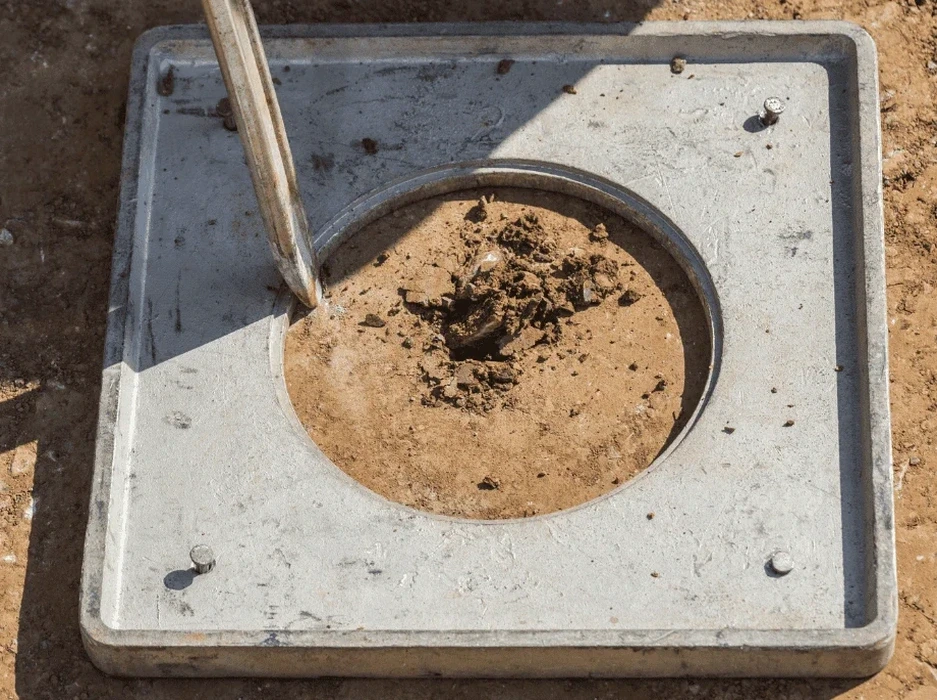
The split-spoon sampler hammers into silty sand at 30 blows per foot and we know right away — this material demands a cyclic stress evaluation. Milwaukee's glacial and post-glacial deposits create a patchwork of saturated granular soils that behave unpredictably under seismic loading. A standard SPT boring logs blow counts, but interpreting those numbers for liquefaction potential requires Seed & Idriss simplified procedures and site-specific fines content from grain-size analysis. We run these correlations daily for projects along the Lake Michigan shoreline and in the Menomonee Valley, where groundwater sits just four to six feet below grade. The combination of shallow water table, loose density, and the Proterozoic bedrock depth makes standard foundation assumptions risky without a proper cyclic resistance ratio calculation.
A fines content shift from 15% to 35% can double the cyclic resistance ratio — skipping wash-sieve analysis on Milwaukee silty sands is a gamble no foundation engineer should take.
Our approach and scope
Glacial Lake Milwaukee left behind thick sequences of lacustrine clay interbedded with silty sand lenses — exactly the stratigraphy where pore pressure buildup becomes critical during the 2,475-year return period earthquake. Our analysis pairs field SPT data from
spt-drilling borings with cyclic triaxial testing on undisturbed Shelby tube samples. We also push
cpt-test soundings when continuous cone tip resistance profiles are needed to catch thin liquefiable seams that spoon sampling might miss. The IBC 2021 classifies much of Milwaukee County as Site Class D or E, meaning site-specific ground motion amplification factors drive foundation design loads. We calculate the factor of safety against liquefaction at each foot of depth, then estimate post-liquefaction settlement using Tokimatsu & Seed volumetric strain correlations. For clients requiring performance-based assessment, we run one-dimensional site response models incorporating modulus reduction curves derived from resonant column tests on local soil specimens.
The key distinction in our Milwaukee workflow is accounting for the stiff clay crust — that overconsolidated till cap suppresses surface manifestation but doesn't eliminate deep-seated bearing loss. We've seen projects where the crust thickness alone convinced engineers to skip a
seismic-microzonation study, only to encounter differential settlement issues during construction dewatering.
Local geotechnical context
In Milwaukee we frequently encounter a scenario that textbook analysis misses: the layered profile where a clean sand seam sits trapped between two clay layers. Standard SPT-based liquefaction assessment averages over a 12-inch sample interval, potentially diluting the blow count if the spoon crosses a boundary. The clean sand seam liquefies, but the overlying clay prevents drainage — pore water pressure gets trapped, and the sand boils upward the moment a construction excavation breaches the clay cap. We've documented this mechanism in post-construction forensic investigations near the Port of Milwaukee, where sheet pile driving triggered localized sand boils within hours. The regulatory consequence is equally serious: Wisconsin Commercial Building Code chapter SPS 362 adopts IBC Chapter 18 with state-specific amendments for soil reports. A geotechnical report submitted without liquefaction screening on a Site Class E profile can trigger plan review rejection and a six-to-eight week resubmission delay. Developers along the Kinnickinnic River corridor face this exact timeline risk, where the organic silt overbank deposits classify as liquefiable under moderate shaking despite their cohesive appearance in hand samples. The lab proctor says it's clay — the fines content under ASTM D2487 says otherwise.
Relevant standards
ASCE 7-16 Chapter 20: Site Classification Procedure for Seismic Design, IBC 2021 Section 1803: Geotechnical Investigations — Liquefaction Potential Required for Site Class D, E, and F, ASTM D1586: Standard Test Method for Standard Penetration Test (SPT) and Split-Barrel Sampling of Soils, ASTM D2487: Standard Practice for Classification of Soils for Engineering Purposes (Unified Soil Classification System), ASTM D5311/D5311M: Standard Test Method for Load Controlled Cyclic Triaxial Strength of Soil, Wisconsin Administrative Code SPS 362: Commercial Building Code (adopts IBC with WI amendments)
Quick answers
At what depth does liquefaction risk become negligible in Milwaukee?
For Milwaukee's glacial stratigraphy, the risk typically diminishes below 50 feet where overburden pressure increases confinement enough to suppress pore pressure buildup. However, the exact cutoff depends on soil density and fines content at depth. We've identified liquefiable silty sand lenses at 65 feet in deep boreholes near the Lake Express ferry terminal, where the preconsolidation from glacial ice was insufficient to densify those specific depositional units. The IBC requires investigation to at least 50 feet or bedrock, whichever is shallower, but we recommend extending borings to 75 feet for critical structures in Site Class E areas.
What's the cost range for a complete liquefaction analysis on a Milwaukee commercial lot?
For a standard commercial lot in Milwaukee County, a complete liquefaction analysis — including two SPT borings to 60 feet, CPT soundings, laboratory classification testing (wash-sieve and Atterberg limits), and the engineering report with CSR/CRR calculations and settlement estimates — typically ranges from US$2,400 to US$3,960. The final cost depends on boring depth, number of samples requiring cyclic triaxial testing, and whether site-specific ground motion parameters need extraction from USGS hazard curves for the exact project coordinates.
Does Milwaukee's building code require liquefaction analysis for residential construction?
Wisconsin SPS 362 adopts IBC Chapter 18, which requires liquefaction potential evaluation when the site is classified as Site Class D, E, or F under ASCE 7 and the mapped spectral acceleration exceeds certain thresholds. Many residential parcels in the Menomonee Valley, Harbor District, and near the Milwaukee River floodplain fall into these site classes due to soft soil profiles. Single-family homes on spread footings in Site Class D may not trigger the requirement, but multi-family or mixed-use buildings with basement levels almost always do. The local building official has authority to request a geotechnical report with liquefaction screening even for projects below the code threshold if historical site conditions suggest risk.
How do you handle the stiff clay crust in Milwaukee when evaluating liquefaction?
The overconsolidated till cap — typically 8 to 15 feet thick in Milwaukee — creates a non-liquefiable crust that we model as a 'cap' layer in our settlement calculations. The crust suppresses sand boil manifestation at the surface, but it doesn't prevent liquefaction in the underlying sand. Our analysis separates the crust from the liquefiable layer, computes volumetric strain in the sand below, and then calculates the consolidation settlement transmitted through the crust. For structures with shallow foundations, we check whether the differential settlement from irregular crust thickness exceeds tolerable angular distortion. In areas where the crust is thinner than 5 feet — common near the Kinnickinnic River — we recommend ground improvement or deep foundations rather than relying on the crust to bridge over liquefied zones.
What ground improvement methods are most effective for Milwaukee's liquefiable soils?
For the silty sand and sand-with-silt deposits typical of Milwaukee's lake plain, vibrocompaction and stone columns are the most commonly applied techniques. Vibrocompaction works well when fines content stays below 15% — the vibratory probe densifies the granular skeleton through particle rearrangement. When fines exceed 15%, we specify stone columns installed via bottom-feed vibro-replacement, which offer both densification and drainage paths to dissipate excess pore pressure during shaking. Compaction grouting is less effective in these soils due to the lenticular stratigraphy; the grout tends to follow preferential pathways rather than creating uniform densification bulbs. Deep soil mixing has been used successfully on two recent Milwaukee projects near the port, where the combination of liquefaction mitigation and settlement control justified the higher mobilization cost.