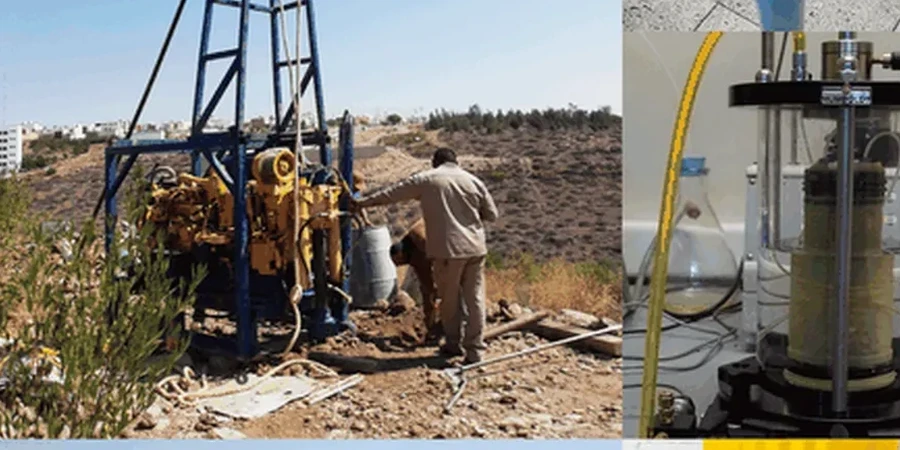
The geophone spread stretches across the site near the Menomonee Valley, a sledgehammer striking the aluminum plate cleanly against compacted glacial till. That sharp acoustic pulse travels downward, refracting off dolomite bedrock before returning to surface receivers. In Milwaukee, our field crews run these 24- and 48-channel spreads regularly because the Silurian dolomite underlying much of the county sits at wildly variable depths—anywhere from 10 to over 100 feet—and guessing wrong during excavation costs real money. We use both seismic refraction and high-resolution reflection methods, paired with CPT testing in areas where the overburden is too soft for reliable shear-wave picks, and MASW surveys for the upper 30-meter Vs profile needed to nail down the IBC seismic site class before structural design begins. The data processing chain uses iterative tomography algorithms that honor actual ray paths through Milwaukee's layered till, lake deposits, and occasional organics in the Estabrook Park area.
Refraction alone misses the shale beneath Milwaukee's dolomite. Reflection cross-check catches it every time.
Local geotechnical context
Lake Michigan's freeze-thaw cycles work the upper soil column in Milwaukee's near-shore neighborhoods—Bay View, Third Ward, Harbor District—where groundwater perched on fractured dolomite creates unpredictable void zones. Seismic tomography detects these low-velocity anomalies before an excavator bucket finds them the hard way. Winter scheduling also matters: frozen ground couples the geophone spike differently, damping the high-frequency content needed for shallow resolution. We shift to reflection-dominant surveys during January and February, using buried geophones and heavier impact sources to maintain signal-to-noise ratio through the frost line. The IBC requires site-specific Vs30 measurements for structures over three stories, and Milwaukee's Department of Neighborhood activities engineering division checks seismic hazard compliance during plan review. A tomography survey that skips the reflection tie-in risks misclassifying a site with hidden soft shale as competent rock—a Class C to Class D downgrade that adds six figures to lateral system costs on a mid-rise.
Quick answers
What does a seismic tomography survey cost for a typical Milwaukee commercial lot?
For a standard commercial lot in Milwaukee County—say a half-acre parcel with 24-channel refraction and reflection overlay—budget between US$2,620 and US$5,720. The spread depends on line length, number of spreads, and whether we need to add MASW for the IBC Vs30 determination. Sites with heavy surface infrastructure or tight access near downtown may push toward the upper end due to extra setup time and alternative shot patterns.
How deep can you see with seismic refraction in Milwaukee's glacial soils?
Depth depends on spread length, not signal strength. A 230-foot spread typically resolves to about 50-70 feet with a sledgehammer source. For deeper targets—like bedrock mapping for deep basements in the East Side—we extend spread length or switch to a weight-drop source, which can push refraction coverage past 100 feet through competent till. The limiting factor is often the velocity inversion at the dolomite-shale contact, which is why we always recommend a reflection overlay for sites where depth-to-bedrock exceeds 60 feet.
Does Milwaukee require seismic site classification for building permits?
Yes, the city enforces IBC Chapter 16 through the Department of Neighborhood activities plan review process. Any structure assigned to Seismic Design Category C or higher needs a site-specific Vs30 measurement. We handle the full workflow: seismic tomography for the velocity profile, MASW for the upper 30-meter average, and a sealed report with the IBC site class letter (A through F) ready for permit submission.