← Home · Slopes & Walls

Slope Stability Analysis in Milwaukee: Practical Geotechnical Assessment for Lake Bluff Terrain

Together, we solve the challenges of tomorrow.

LEARN MORE →

A contractor called us last spring about a retaining wall failing on a residential lot off Lake Drive. The slope looked stable from the street, but three weeks of rain had saturated the upper silty layer. We mobilized within 48 hours and ran a slope stability analysis using shear strength parameters from consolidated-undrained triaxial tests on undisturbed Shelby tube samples. Milwaukee's lakefront bluffs are deceptive. The stratigraphy changes fast. You can hit dense gray till at 12 feet in one borehole and find soft lacustrine clay at 8 feet just 30 yards east. That's why we don't rely on regional correlations alone. We drill, sample, and model each slope with site-specific data. For projects near the Menomonee River or along the Kinnickinnic corridor, we often combine our analysis with footing design recommendations when the structure sits near the crest. The city's building department expects calculations that account for seasonal groundwater fluctuation, and we deliver that with every report.

Factor of safety isn't a design target. It's a diagnostic tool that tells you what the soil is already trying to communicate.

Our approach and scope

One mistake we see too often: an engineer specifies a 1V:2H slope based on a desktop study, then excavation hits a lens of water-bearing sand that wasn't mapped. Now the cut is unstable and the contractor is losing days. A proper slope stability analysis in Milwaukee requires actual soil parameters from the site, not textbook assumptions. We follow ASTM D2487 for classification and run drained and undrained scenarios depending on the loading timeline. Key steps include: The Wisconsin Department of Transportation has specific requirements for cuts along state highways, and we reference their geotechnical manual in our submittals. For steep ravine slopes in Shorewood or Whitefish Bay, we also evaluate toe erosion potential from wave action on Lake Michigan, which can undercut the slope over time.
Slope Stability Analysis in Milwaukee: Practical Geotechnical Assessment for Lake Bluff Terrain
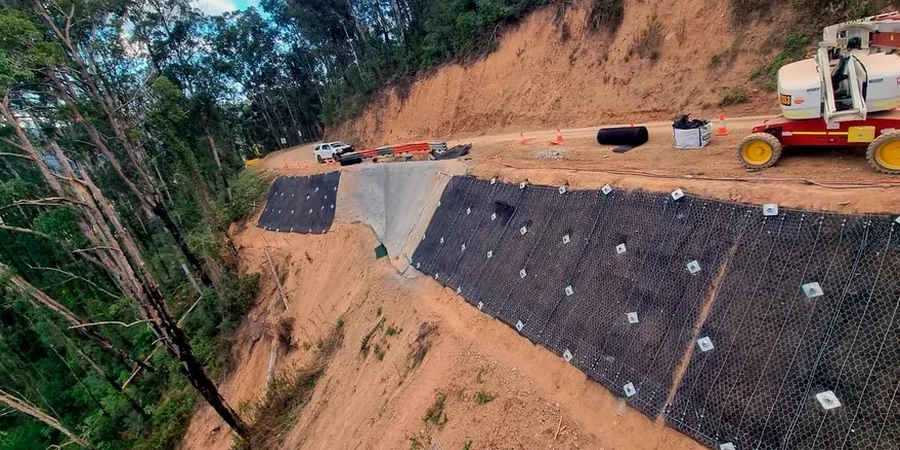
Technical reference image — Milwaukee

Local geotechnical context

We run the analysis on a workstation with slope stability software that iterates thousands of slip surfaces in minutes, but the real work happens before the model opens. It's the logging of Shelby tubes on the tailgate of the drill rig in sub-freezing February temperatures on Milwaukee's east side. That's where you catch the thin silt seam that controls the failure plane. The biggest risk in this city isn't a mathematical error. It's missing a weak layer that standard SPT intervals skip over. Glacial stratigraphy in Milwaukee County is notoriously discontinuous. The Oak Creek Formation can include interbedded sand, silt, and clay lenses deposited by proglacial lakes. We have seen slopes fail at 1V:3H because a 6-inch clayey silt layer wasn't identified during the investigation. Our process includes continuous sampling in the upper 20 feet in ravine settings and pore pressure dissipation tests when we suspect artesian conditions, which occur more often than people realize near the deep bedrock valley under downtown.

Need a geotechnical assessment?

Reply within 24h.

Email: contact@geotechnicalengineering1.org

Technical parameters

ParameterTypical value
Modeling methodLimit equilibrium (Spencer, Morgenstern-Price)
Soil shear strengthDirect shear (ASTM D3080) or CIU triaxial (ASTM D4767)
Groundwater analysisPiezometer monitoring + steady-state seepage modeling
Seismic coefficient (kh)Per IBC/ASCE 7 site classification, typically 0.08-0.15g
Minimum FoS (static)1.5 for permanent slopes per local practice
Sample typeShelby tube, split spoon, block samples for stiff clays

Other technical services

01

Slope Stability Modeling

Limit equilibrium analysis with pore pressure integration. We model existing slopes, proposed cuts, and fills using lab-derived shear strength data.

02

Subsurface Investigation

Rotary drilling, SPT sampling, and Shelby tube recovery in Milwaukee County. We handle permits for work near DNR-regulated waterways.

03

Retaining Structure Design

When slopes can't meet code, we design anchored walls, MSE walls, or cantilever walls with drainage provisions for freeze-thaw cycling.

04

Construction Monitoring

Slope inclinometer and piezometer installation during excavation. We track lateral movement weekly and flag threshold exceedances immediately.

Relevant standards

ASTM D1586 – Standard Test Method for SPT and Split-Barrel Sampling, ASTM D2487 – Classification of Soils for Engineering Purposes (USCS), ASTM D4767 – Consolidated-Undrained Triaxial Compression Test, IBC 2021 – Seismic design parameters, site class determination, ASCE 7 – Minimum Design Loads (seismic coefficient selection), WisDOT Geotechnical Manual – Slope stability requirements for state ROW

Quick answers

What does a slope stability analysis cost in Milwaukee?

Typical range is US$1,280 to US$3,990 depending on slope height, number of cross-sections, and whether lab testing is already available. A simple single-section analysis with existing data runs on the lower end. A multi-section model with new triaxial testing, piezometer data, and seismic analysis approaches the upper bound.

How long does it take to get results?

If drilling is complete and lab data is in hand, we can deliver a preliminary model in 5 to 7 business days. When we manage the full investigation, expect 3 to 4 weeks including drilling, lab turnaround, and final reporting.

Do you need a geotechnical report first?

Yes. We need SPT blow counts, soil descriptions, and lab shear strength values as input. If you don't have that, we can scope and execute the subsurface investigation first, then feed those results directly into the slope model.
Location and service area

We serve projects in Milwaukee and surrounding areas.

View larger map