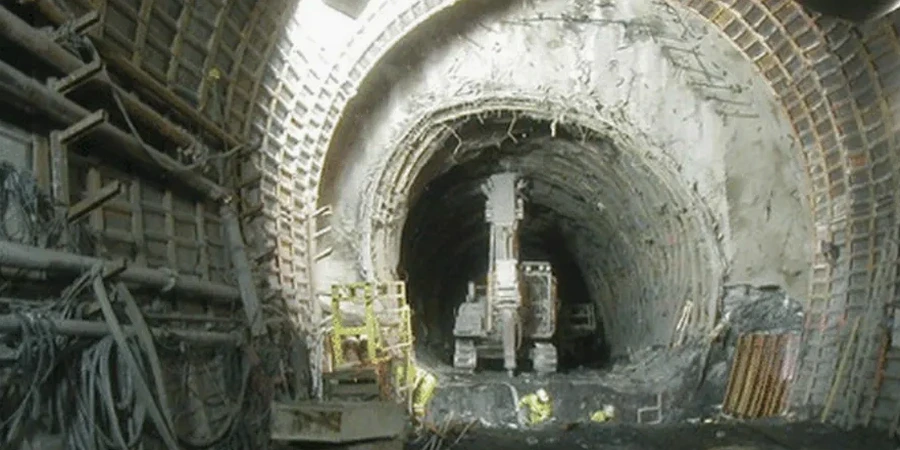
Milwaukee's tunnel infrastructure grew from the deep sewer project of the late 1800s, when engineers first hit the compressible lacustrine clays that sit below the city. Those same soft deposits, left by glacial Lake Michigan, still challenge every underground project today. Our lab runs geotechnical analysis for soft soil tunnels on samples pulled from the Menomonee Valley to the East Side bluffs. We measure undrained shear strength, consolidation parameters, and sensitivity of the local gray clay. The data feeds directly into face pressure calculations and settlement predictions. Before a TBM advances through Milwaukee's saturated silts, the ground behavior needs to be nailed down with lab data, not just assumed from SPT blow counts. We work with contractors who supplement their site investigation with CPT testing to get continuous stratigraphy, then send undisturbed samples to our lab for the critical strength and compressibility tests that define the tunnel alignment.
Milwaukee's lacustrine clays don't give warning before they squeeze. Lab consolidation and triaxial data are the only way to set realistic face pressure.
Our approach and scope
A common mistake we see on Milwaukee tunnel projects is relying on standard penetration resistance alone and skipping consolidation tests on the fat clays. N-values might look acceptable, but the soil's time-dependent settlement under tunnel unloading can be severe. Our geotechnical analysis for soft soil tunnels targets the parameters that actually govern excavation behavior: compression index, recompression index, coefficient of consolidation, and undrained shear strength from triaxial compression. We test specimens at in-situ stress levels to replicate the unloading path the tunnel creates. Milwaukee's stiff upper crust often overlies softer layers at depth, and misreading that transition zone leads to face instability. We run staged triaxial tests with pore pressure measurement, giving the designer a clear picture of effective stress response. The lab also measures Atterberg limits and natural water content on every sample, because the local silty clays can be surprisingly sensitive when remolded by the cutterhead.
Local geotechnical context
A tunnel drive under the Third Ward hit a pocket of organic silt that wasn't flagged in the geotechnical baseline report. The TBM face pressure, calibrated for the stiffer clay above, was too low. The ground squeezed, surface settlement exceeded an inch, and a century-old brick building needed emergency underpinning. That scenario replays in Milwaukee because the glacial stratigraphy is erratic: peat lenses, interbedded sand seams, and soft gray clay all sit within the same tunnel horizon. Without lab-measured strength and consolidation parameters specific to each soil unit, the contractor flies blind. The geotechnical analysis for soft soil tunnels reduces that risk by quantifying the stiffness contrast between layers. Once we know the undrained strength ratio and sensitivity of each unit, the design team can adjust the confinement pressure and grouting strategy before the cutterhead reaches the transition. It's cheaper to test a Shelby tube than to repair a historic facade.
Quick answers
What lab tests are essential before tunneling through Milwaukee's soft clays?
At minimum: CIUC triaxial for undrained shear strength, oedometer consolidation for compressibility and OCR, and Atterberg limits with natural water content to assess sensitivity. If the alignment crosses interbedded sands and silts, we add particle size distribution by hydrometer. The testing program should target each distinct soil unit encountered in the borings, not just the weakest layer.
How long does the lab testing take for a tunnel geotechnical analysis?
Consolidation tests run the longest because each load increment requires pore pressure dissipation. A standard oedometer test takes 5 to 7 days. Triaxial CIUC testing runs about 2 to 3 days per specimen. A full package for a single borehole with three specimens typically ships results within 10 working days after sample receipt.
What does geotechnical analysis for soft soil tunnels cost in Milwaukee?
Testing packages range from US$3,770 for a basic classification and strength set on one borehole to US$18,120 for a comprehensive program covering multiple soil units with consolidation, triaxial, and sensitivity testing. The scope depends on tunnel length and stratigraphic complexity.