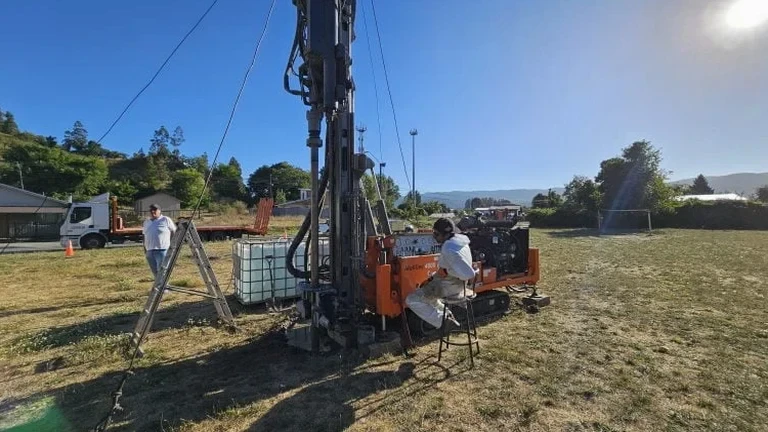
Milwaukee’s geotechnical character is inseparable from its glacial past: the Lake Michigan Lobe left behind a complex sequence of tills, lacustrine silts, and outwash sands that vary dramatically over short distances. Foundation design in this city confronts a soil profile where stiff, overconsolidated Oak Creek till can sit directly above soft, compressible Estuarine deposits — a juxtaposition that demands direct visual inspection before any structural load calculation. An exploratory test pit provides exactly that: physical access to the subsurface, allowing the geotechnical engineer to log stratigraphy, assess moisture conditions, and extract undisturbed block samples. Unlike borehole-only investigations, test pits reveal macrostructure — fissures, oxidation zones, cobble content — that SPT blow counts alone cannot interpret. We combine this field technique with a CPT test to extend stratigraphic correlation beyond the pit depth, and grain-size analysis to classify the glacial units encountered.
A single test pit in Milwaukee’s layered glacial deposits reveals more about soil macrostructure than a week of SPT logs — fissures, cobble trains, and perched water tell the real story.
Local geotechnical context
The most common — and costly — mistake made in Milwaukee’s infill development projects is assuming that the near-surface brown clay is a uniform glacial till. In reality, many east-side and Walker’s Point sites overlie a buried marsh sequence: fibrous peat and organic silt that oxidizes rapidly upon exposure and can lose 40% of its volume under load. A contractor who proceeds with a shallow footing design based solely on a few auger samples risks differential settlement that shows up within two freeze-thaw cycles. An exploratory test pit exposes this organic layer visually, allowing the geotechnical team to measure its true thickness and recommend excavation and replacement with engineered fill — a decision that is impossible to make confidently from disturbed cuttings alone. The pit also provides the only practical means to inspect the condition of existing foundations during a renovation, revealing cracks, undermining, or sulfate attack in concrete that core sampling would miss.
Quick answers
When does Milwaukee code require a test pit instead of just a boring?
The City of Milwaukee Department of Neighborhood activities typically accepts standard boring logs for most permitting. However, when the site lies within a mapped floodplain, adjacent to a historic filled watercourse, or when the project involves underpinning existing foundations, the geotechnical report gains significant credibility with a direct visual inspection from an exploratory test pit. It is not a strict code mandate but a professional standard of care — especially given the buried organic deposits common along the lakefront and river corridors.
What is the cost range for an exploratory test pit in Milwaukee?
For a standard machine-excavated test pit with logging, sampling, and backfill, the cost typically falls between US$520 and US$820. Variables include pit depth, access constraints that require a smaller excavator, and whether laboratory testing of recovered samples is included in the scope.
How deep can you go and still keep the pit safe?
OSHA 1926 Subpart P governs. A competent person must classify the soil before entry. In Milwaukee’s Type B glacial till, a simple slope of 1:1 (horizontal:vertical) is often acceptable to 14 feet. In Type C sand layers below the water table, benching or hydraulic shoring becomes mandatory. We plan the excavation method based on the expected stratigraphy from nearby well logs.
Can you take undisturbed samples from the pit walls?
Yes — block samples carved by hand from a cleaned pit face offer the highest-quality undisturbed specimens for triaxial testing or consolidation analysis. We also drive Shelby tubes horizontally into the wall when the material is fine-grained and cohesive enough to retain structural integrity during transport to the lab.
What happens to the pit after the investigation is complete?
Backfilling follows the same compaction specification as engineered fill: lifts of 8 to 12 inches, moisture-conditioned, and compacted to 95% of Standard Proctor density. In pavement zones, we place a compacted clay plug in the upper 2 feet to prevent a future depression. The site is restored to grade and safe for construction traffic immediately after.