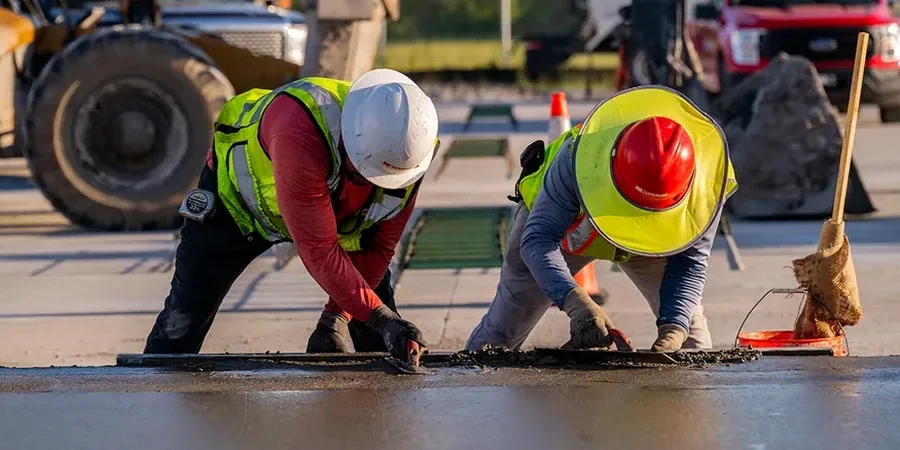
Milwaukee's industrial backbone has always moved on concrete. From the Menomonee Valley's rail corridors to the Port of Milwaukee's heavy container yards, the city's growth demanded surfaces that could take a beating and keep performing. Rigid pavement design here is shaped by a very specific reality: the ground beneath a slab can be saturated clay one season and frozen solid the next. Our technical team approaches each project by first reconciling the structural demands of the traffic load with the subgrade's seasonal behavior. A thorough test pits investigation lets us log the actual soil profile and water table depth under your site, which is the starting point for any defensible pavement section. For distribution centers out near Oak Creek or redeveloped brownfields in the Harbor District, we tie the concrete thickness, joint spacing, and load transfer design directly to the geotechnical parameters measured in the field, not just to a generic AASHTO table.
A well-designed rigid pavement in Milwaukee is a thermal and structural system, not just a concrete slab; the joint layout and base drainage dictate whether it lasts 12 years or 30.
Local geotechnical context
A slip-form paver laying down a 26-foot-wide pass on a Milwaukee county highway is only as good as the subgrade it rides on. If the trimmer hits a pocket of saturated organic silt that wasn't mapped during the site investigation, the uniform support assumption collapses, and so will the slab under heavy truck traffic. The failure mode is rarely dramatic at first; it starts with minor faulting at the transverse joints after a couple of freeze-thaw cycles. Water infiltrates, the base erodes, and pumping action begins. By year five you're looking at cracked panels and a maintenance liability. Because so much of the Milwaukee area sits on compressible, moist clay, we insist on the plate load test to empirically derive the modulus of subgrade reaction (k-value) in critical loading zones like crane pads, waste transfer stations, and intermodal freight terminals. The test eliminates the guesswork in k-value estimation, directly reducing the risk of thickness underdesign.
Quick answers
What does rigid pavement design cost for a Milwaukee industrial lot?
Engineering fees for a complete rigid pavement design package, including geotechnical investigation, thickness design, and jointing plans, typically range from US$1,780 to US$5,590 depending on the paved area and the number of borings or plate load tests required. An access road with one boring and basic joint layout is at the lower end; a truck terminal with heavy forklift traffic, multiple loading zones, and detailed reinforcement specifications falls at the upper end.
How deep do you need to investigate the soil for a concrete pavement in Milwaukee?
Borings or test pits should extend to a depth of at least 1.5 times the pavement thickness plus the depth of significant stress influence, and always below the frost penetration depth. In Milwaukee that means a minimum of 6 to 8 feet below the proposed subgrade elevation, deeper if soft clay layers are encountered. This captures the seasonal moisture variation zone and any compressible strata that could cause differential settlement.
Do you use the AASHTO 1993 method or the newer MEPDG for design?
We work with both, but for most Milwaukee industrial and commercial projects the AASHTO 1993 method remains the contractual and practical standard. It aligns directly with the empirical k-value, CBR, and flexural strength inputs we measure in the field. When a project requires a performance-based analysis under specific climate and traffic spectra, we apply the Mechanistic-Empirical Pavement Design Guide (MEPDG) using local Wisconsin climatic data files.
What makes concrete pavement different from asphalt in terms of subgrade requirements?
Concrete distributes wheel loads over a wider area through slab action, so point pressures on the subgrade are lower than under flexible asphalt. However, concrete is far less tolerant of non-uniform support. A soft spot that might cause a slowly developing rut in asphalt can cause a structural crack in a rigid slab within months. That is why we focus on uniform compaction, positive drainage, and a consistent base layer; the goal is to avoid any void that allows the slab to flex beyond its modulus of rupture.