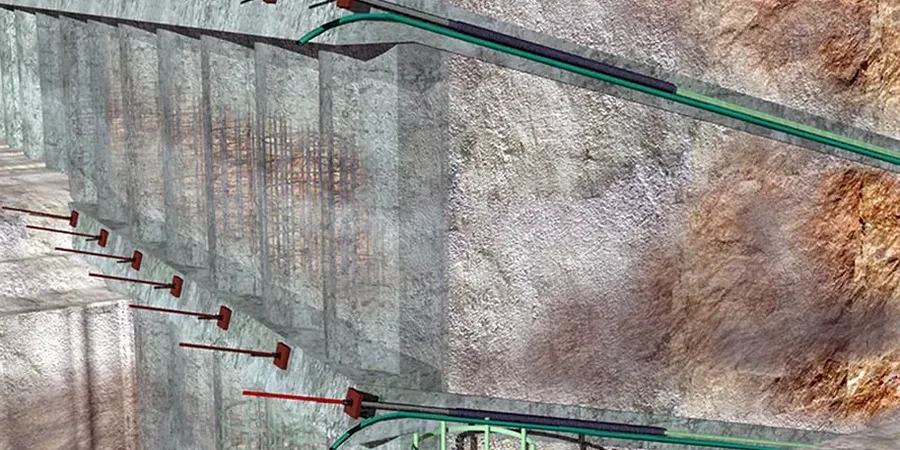
Milwaukee's elevation of 617 feet above Lake Michigan doesn't tell the whole story of what lies beneath the surface. The city sits atop a complex sequence of glacial tills, lacustrine clays, and engineered fill—remnants of the last ice age that still dictate how we approach deep excavations and earth retention today. Designing an anchor system here means grappling with groundwater intrusion from the lake, artesian pressures in the deeper dolomitic aquifer, and a freeze-thaw cycle that tests every grout bond over decades. In our knowledge, the difference between a successful tieback and a costly remedial repair often comes down to how thoroughly the subsurface investigation captured the lensing and variability typical of southeastern Wisconsin. That's why we pair anchor design with a disciplined test pits program to identify soft pockets before finalizing bond lengths.
A well-designed anchor in Milwaukee's glacial soils transfers load into the ground quietly—until the first January thaw reminds you why grout curing time matters.
Relevant standards
IBC 2021 Chapter 18 (Soils and Foundations), ASCE 7-22 Minimum Design Loads for Buildings and Other Structures, PTI DC35.1-14 Recommendations for Prestressed Rock and Soil Anchors, ASTM A416/A416M-18 Standard Specification for Low-Relaxation, Seven-Wire Steel Strand, WisDOT Standard Specifications Sections 505 and 511
Quick answers
How much does a typical active anchor design package cost for a project in Milwaukee?
For a standard commercial or residential excavation in the Milwaukee area requiring active tieback design, the engineering package—including subsurface review, load calculations, corrosion protection specification, and construction-phase submittal review—ranges from US$890 to US$3,300 depending on the number of anchor rows and the complexity of the soil profile. Projects involving MMSD coordination or historic preservation review tend toward the upper end of that range.
Which testing method confirms the anchor bond capacity in Milwaukee's glacial soils?
We specify a performance proof test on every production anchor, loading to 133% of the design load per PTI DC35.1 guidelines. The test uses an in-line hydraulic jack with a calibrated load cell, and we record movement at the anchor head with a dial gauge reading to 0.001 inches. In the lacustrine clays common along the lakefront, we extend the creep test to a full 60 minutes because short-term behavior can mask long-term relaxation in these low-permeability soils.
Can passive anchors work in the soft fill found near Milwaukee's rivers?
Passive anchors can work, but they require careful design when dealing with the post-industrial fill and organic silts along the Milwaukee, Menomonee, and Kinnickinnic river corridors. We typically specify longer grouted bond zones—sometimes extending 30 feet or more—to reach competent glacial till beneath the fill. Even then, we recommend a pre-production anchor test to verify the bond stress assumptions, because fill variability in this area is too high to rely solely on published empirical values.