← Home · Underground Excavations

Geotechnical Design of Deep Excavations in Milwaukee

Together, we solve the challenges of tomorrow.

LEARN MORE →

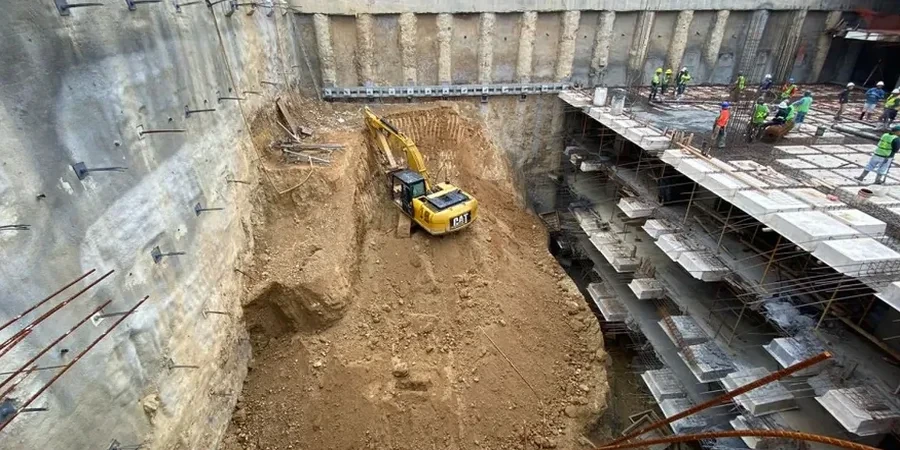
Milwaukee's downtown rests on a complex glacial geology where Silurian dolomite bedrock sits beneath compressible lakebed clays and dense glacial till — a profile that demands precise deep excavation design. The water table often sits just 10 to 15 feet below grade near the Milwaukee River and Lake Michigan shoreline, requiring solid dewatering and lateral support strategies before a single bucket hits the ground. Our team analyzes in-situ stress states, soil-structure interaction, and staged construction sequencing for cuts exceeding 20 feet. When site conditions call for detailed stratigraphic verification, we integrate data from test pits to calibrate borehole logs against visible strata, ensuring the design model reflects reality.

In downtown Milwaukee, the depth to competent dolomite — not just the excavation depth — dictates the shoring system's cost and schedule.

Our approach and scope

In Milwaukee, we consistently observe that the transition zone between weathered dolomite and intact bedrock governs the performance of tieback anchors and soldier pile walls. A design that treats this contact as a uniform surface often fails to predict local overbreak and load redistribution during excavation. We model the non-linear stiffness of the Estonian till and the underlying Niagara dolomite using finite element analysis, incorporating pore pressure dissipation rates measured via field piezometers. For sites near the Third Ward or Walker's Point, where buried organic silts and old river channels complicate shoring, we cross-reference design parameters with CPT test data to delineate soft pockets that could trigger basal heave during dewatering.
Geotechnical Design of Deep Excavations in Milwaukee
Technical reference image — Milwaukee

Local geotechnical context

Milwaukee's winter freeze-thaw cycles introduce a seasonal risk rarely accounted for in generic excavation plans. The upper 3 to 5 feet of stiff clay can lose cohesion rapidly during spring thaw, leading to surficial sloughing behind lagging that underestimates lateral loads on walers. Combined with the city's combined sewer overflow tunnels and century-old utility corridors threading through the downtown grid, any deep excavation becomes a three-dimensional problem. A poorly staged excavation sequence near these legacy structures can induce differential settlement exceeding 0.5 inches, cracking brick facades on historic buildings from Brady Street to Bay View. We map adjacent infrastructure vulnerability before finalizing the bracing layout to limit ground loss at every construction stage.

Need a geotechnical assessment?

Reply within 24h.

Email: contact@geotechnicalengineering1.org

Technical parameters

ParameterTypical value
Typical bedrock depth (downtown)15 - 45 ft
Design groundwater level10 - 15 ft below grade
Active earth pressure coefficient (till)Ka = 0.28 - 0.33
Unconfined compressive strength (dolomite)12,000 - 25,000 psi
Undrained shear strength (lake clay)Su = 800 - 1,500 psf
Design seismic coefficient (Ss)0.15 - 0.25g (per ASCE 7-22)
Maximum unsupported cut in clay≤ 8 ft (per OSHA Subpart P)

Other technical services

01

Braced Excavation Analysis

Complete design of soldier pile and lagging, secant pile, or diaphragm walls for Milwaukee sites. We calculate bending moments, shear, and deflections under staged excavation loading, integrating the effect of adjacent footings and traffic surcharge per IBC requirements.

02

Dewatering and Base Stability

Assessment of hydraulic uplift and basal heave potential in Milwaukee's layered soils. We design well point and deep well systems to lower the groundwater table below subgrade, verifying critical gradient and piping resistance in silty till zones.

Relevant standards

ASCE 7-22 Minimum Design Loads for Buildings, IBC 2021 Chapter 18 (Soils and Foundations), ASTM D1586 Standard Test Method for SPT, OSHA 29 CFR 1926 Subpart P (Excavations), FHWA GEC No. 4 Ground Anchors and Anchored Systems

Quick answers

How does Milwaukee's geology affect the cost of a deep excavation design?

The depth to competent dolomite bedrock is the primary cost driver. A 25-foot excavation entirely within glacial till with tieback anchors runs between US$1,970 and US$4,200 for design. If the cut extends into weathered or intact dolomite requiring rock anchors and controlled blasting analysis, the design scope increases, ranging from US$4,500 to US$9,600 depending on the linear footage of shoring and complexity of the instrumentation plan.

What is the typical review timeline with Milwaukee's Department of Neighborhood Services?

The DNS Plan Review process for excavation shoring typically requires 15 to 20 business days for initial comments. We submit sealed calculations and drawings compliant with IBC 2021 Chapter 18 and the Wisconsin Administrative Code SPS 321. A pre-submission meeting with the plan examiner can reduce review cycles, especially for projects involving street occupancy permits near MCTS transit corridors.

Do you account for frost depth in Milwaukee's excavation support design?

Absolutely. Milwaukee's code-specified frost penetration depth is 48 inches, and we design the upper portion of lagging and walers to resist the increased lateral pressures from frozen soil expansion. We also specify that exposed lagging faces be insulated or backfilled before sustained freezing temperatures arrive, preventing ice lens formation that can overload the upper brace level.

How do you handle adjacent historic structures during a deep dig in Milwaukee?

We conduct a pre-construction condition survey of adjacent properties within the zone of influence — typically a distance equal to 1.5 times the excavation depth. Our design limits calculated lateral wall movement to less than 1.0 inch and vertical settlement to under 0.5 inches for unreinforced masonry buildings common in the Historic Third Ward. We specify vibrating wire piezometers and inclinometers with twice-weekly readings during active excavation.
Location and service area

We serve projects in Milwaukee and surrounding areas.

View larger map