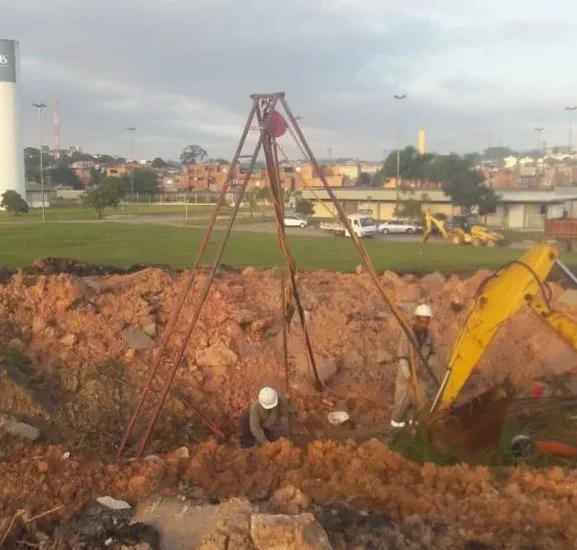
The Unified Soil Classification System (USCS) per ASTM D2487 remains the foundation for every geotechnical report in southeastern Wisconsin, and nowhere is it more critical than in Milwaukee, where the subsurface is a complex layering of glacial tills, lacustrine deposits, and the occasional organics along the river valleys. When you encounter fine-grained material during a site investigation, the Atterberg limits test becomes the primary tool for distinguishing between a low-plasticity silt and a high-plasticity clay — a distinction that directly governs bearing capacity assumptions and excavation safety. Our laboratory team processes hundreds of these samples each year from Milwaukee County projects, from the Menomonee Valley to the bluffs overlooking Lake Michigan, where the soil consistency can shift dramatically within a single boring log. Running the test correctly means understanding that the local geology, shaped by the last glacial retreat some 12,000 years ago, often yields borderline classifications that require careful interpretation beyond the raw numbers. When the plasticity chart points toward challenging behavior, we often recommend pairing the results with a triaxial shear test to define the effective stress parameters for foundation design in these variable Milwaukee deposits.
In Milwaukee's glacial soils, the Atterberg limits test isn't just a classification exercise — it's the earliest warning system for identifying fat clays that can swell, shrink, or lose strength under load.
Local geotechnical context
Milwaukee sits in a region where the depth to competent bedrock varies from near-surface in Wauwatosa to over 100 feet in the downtown river valleys, and much of the overburden consists of fine-grained glacial and post-glacial sediments with moderate to high plasticity. The real geotechnical risk here is misclassifying a lean clay (CL) as a silt (ML) based solely on field identification, which happens more often than anyone wants to admit when the material is cold and damp during a Wisconsin spring excavation. A CL soil with a plasticity index above 15 can develop significant lateral earth pressures against foundation walls, and when combined with Milwaukee's seasonal freeze-thaw cycles — the city averages 130 freeze-thaw days per year — the volume change potential becomes a long-term serviceability concern for shallow footings and slab-on-grade construction. The Atterberg limits test, properly correlated with natural moisture content, gives the design team a liquidity index that predicts whether the in-situ soil is likely to behave as a brittle solid or a viscous fluid under construction loading.
Relevant standards
ASTM D4318-17e1: Standard Test Methods for Liquid Limit, Plastic Limit, and Plasticity Index of Soils, ASTM D2487-17: Standard Practice for Classification of Soils for Engineering Purposes (Unified Soil Classification System), AASHTO T 89/T 90: Determining the Liquid Limit and Plastic Limit of Soils, IBC 2021 Section 1803: Geotechnical Investigations requiring soil classification per USCS, ASCE 7-22 Section 20.3: Site Class definitions requiring PI data for Site Class D and E soils
Quick answers
Why do Atterberg limits matter for a building foundation in Milwaukee?
The Atterberg limits define the moisture content range where the soil behaves plastically, which directly relates to its compressibility, shrink-swell potential, and undrained shear strength. In Milwaukee, where many near-surface soils are fine-grained glacial tills and lacustrine clays, a high plasticity index (PI > 20) signals a soil that will undergo significant volume change with seasonal moisture fluctuations and will require deeper footings or engineered fill to protect the structure.
How much soil is needed to run an Atterberg limits test, and how should the sample be handled?
We require a minimum of 200 grams of material that has passed the No. 40 (425 µm) sieve, which typically means collecting a representative gallon-sized bag of the fine-grained portion from the split spoon or Shelby tube. The sample should be sealed immediately in a moisture-tight container to preserve the natural water content; oven-dried or air-dried samples can still be tested for classification, but we lose the ability to calculate the liquidity index, which is often the most valuable parameter for construction-phase decisions.
What's the typical cost for Atterberg limits testing on a Milwaukee project?
For a single sample determination covering liquid limit, plastic limit, and plasticity index per ASTM D4318, laboratory fees generally range from US$60 to US$90. A combined classification package with a sieve analysis and moisture content runs proportionally higher. The total testing budget depends on the number of strata requiring classification; a typical residential foundation investigation in Milwaukee might involve three to five Atterberg determinations across the borehole depth.
How long does it take to get Atterberg limits results from the lab?
Standard turnaround is three to five business days from sample receipt. The drying and re-wetting cycles for the liquid limit test cannot be rushed without compromising the repeatability of the blow count curve, especially on the low-plasticity silts common in Milwaukee's Oak Creek Formation. We do offer expedited two-day turnaround for active construction cut-and-fill operations where the classification data is needed to confirm borrow source suitability.
Can you use Atterberg limits to predict whether a soil will be expansive?
The plasticity index is a strong indirect indicator of expansion potential: soils with a PI above 25 and a liquid limit above 50 are classified as high-expansion per the Holtz and Gibbs criteria, and we see these values occasionally in the deeper lacustrine clays deposited in the glacial Lake Milwaukee basin. However, a definitive assessment of swell pressure and percent swell requires a one-dimensional swell test (ASTM D4546) on an undisturbed specimen, which we can add to the testing program when the Atterberg results cross those threshold values.