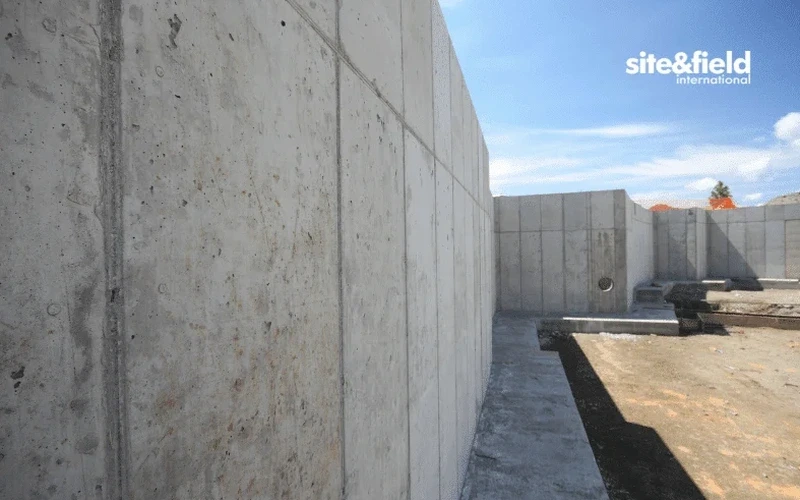
A Caterpillar 320 excavator bucket breaks through frost-susceptible silty clay at a site near the Menomonee Valley. The trench box slides into place and the field team starts logging the stratigraphy. Milwaukee’s glacial till and lacustrine deposits don’t read like textbook soil — the layer sequence shifts within a block, and the groundwater table often sits just six feet below grade. For retaining wall design in Milwaukee, those two variables control everything: lateral earth pressure and drainage. We run consolidated-undrained triaxial tests on Shelby tube samples pulled from the wall alignment, then pair the results with CPT test logs to refine the friction angle and undrained shear strength. Every wall we design — cantilever, gravity, MSE — starts with a boring log stamped by our lab under ASTM D1586 and classified per ASTM D2487.
Milwaukee’s glacial clay demands a drained design approach — ignore pore pressure and the wall moves within two freeze-thaw seasons.
Quick answers
What does retaining wall design in Milwaukee typically cost?
For a typical residential or commercial retaining wall project in Milwaukee, the geotechnical investigation and design report ranges from US$1,040 to US$3,770 depending on wall height, number of borings, and required lab testing. A simple landscape wall under four feet may fall at the lower end, while a tall cantilever wall with triaxial testing and slope stability analysis approaches the upper range.
Do I need a building permit for a retaining wall in Milwaukee?
Yes. The City of Milwaukee Department of Neighborhood activities requires a permit for any retaining wall over four feet in height measured from the bottom of the footing to the top of the wall, or any wall supporting a surcharge. Our design report includes sealed calculations that meet the submittal requirements for the permit application.
How many borings are needed for a retaining wall design?
We typically recommend one boring every fifty linear feet along the wall alignment, with a minimum of two borings per wall. Each boring extends to a depth of at least twice the wall height below the proposed footing elevation. In Milwaukee’s variable glacial deposits, closer spacing catches the lensing that can cause differential settlement.
What drainage provisions do you include in the design?
Every retaining wall design we produce for Milwaukee projects includes a continuous perforated toe drain at the base of the wall, wrapped in filter fabric and connected to a positive outlet. We also specify a twelve-inch minimum thickness free-draining backfill wedge behind the wall stem, with gradation confirmed by lab sieve analysis to contain less than five percent passing the #200 sieve.