← Home · Laboratory

Laboratory CBR Test for Pavement Design in Milwaukee

Together, we solve the challenges of tomorrow.

LEARN MORE →

Too many Milwaukee paving jobs fail early because the subgrade wasn't tested right. A visual check of the soil doesn't cut it. You need a soaked CBR value that reflects what happens after spring thaw and heavy rain. We run laboratory CBR tests on remolded samples compacted at optimum moisture. The result tells your pavement engineer exactly how thick the base and asphalt layers must be. It is the difference between a parking lot that lasts 20 years and one that rutts in two. For full pavement profiles we often pair the flexible pavement design analysis with our lab data to lock in the structural number. Milwaukee clay and silt can look firm in August and turn to sponge in March. Our lab gives you the number that accounts for that.

A soaked CBR of 3 on Milwaukee glacial till can demand double the base thickness of a CBR of 6. The lab test pays for itself in the first truckload of stone you don't buy.
Our approach and scope

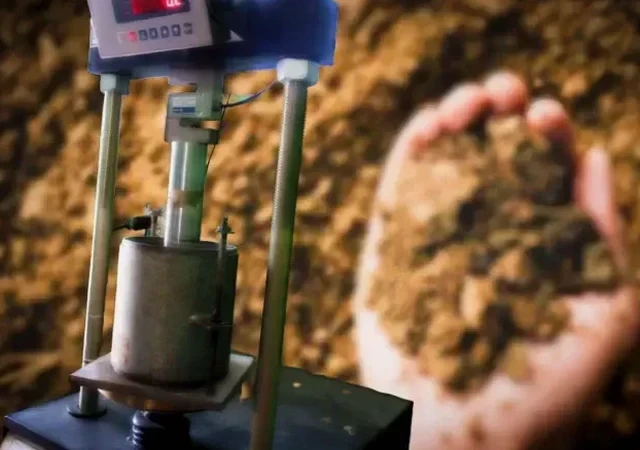
Milwaukee's freeze-thaw cycles punish pavements. The clay-rich glacial till common from the Third Ward to West Allis soaks up water and expands. A dry CBR of maybe 15 drops to 3 or less when saturated. We test this in the lab. Remolded specimens sit in a water bath for 96 hours per ASTM D1883. Then we apply the piston load and plot the stress-penetration curve. The test also monitors swell during soaking. That swell number is critical for rigid pavements and floor slabs. We report CBR at 0.1-inch and 0.2-inch penetration and flag any result where the 0.2-inch value controls. The data feeds directly into the WisDOT pavement design guide and the AASHTO 93 method. Every sample gets a proctor curve first. No exceptions. You cannot run a CBR without knowing the compaction target. Our lab runs modified Proctor per ASTM D1557 as standard for Milwaukee commercial work.
Laboratory CBR Test for Pavement Design in Milwaukee
Technical reference image — Milwaukee

Local geotechnical context

Milwaukee sits at about 581 feet above Lake Michigan, and much of the metro area is built on glacial sediments with high silt content. These soils are frost-susceptible. The 2019 polar vortex event caused widespread pavement heave across the city, with some commercial lots buckling 4 inches. If your subgrade CBR is overestimated, the pavement section will be too thin. Failure shows up as alligator cracking in year three or four. Fixing it costs three times the original paving. We see this pattern repeat in industrial lots near the Port of Milwaukee, where heavy truck traffic accelerates the damage. A laboratory CBR test that properly soaks the sample prevents this. It gives your engineer a realistic strength value for the worst condition the subgrade will see. No contractor wants a callback on a 50,000-square-foot warehouse lot.

Need a geotechnical assessment?

Reply within 24h.

Email: contact@geotechnicalengineering1.org

Technical parameters

ParameterTypical value
Test standardASTM D1883 (Standard Test Method for CBR)
Sample typeRemolded, compacted at optimum moisture content
Soaking period96 hours (4 days) submerged in water
Swell measurementContinuous dial gauge reading during soaking
Surcharge weight10 lb annular weights simulating pavement mass
Penetration rate0.05 in/min per ASTM D1883
Reported valuesCBR at 0.1-inch and 0.2-inch penetration
Compaction referenceModified Proctor (ASTM D1557) standard

Other technical services

01

Soaked CBR with Swell

The WisDOT-standard test. Four-day soak, swell reading each 24 hours, and load-penetration curve. Includes moisture content before and after.

02

Unsoaked CBR for Base Material

For granular base and subbase aggregates. Tested at the as-compacted moisture, no soaking. Quick turnaround for QA/QC on active laydowns.

03

CBR with Soil Classification Package

Combine CBR with grain size analysis and Atterberg limits. You get the full picture: classification per USCS, plasticity index, and soaked strength.

Relevant standards

ASTM D1883 - Standard Test Method for CBR, ASTM D1557 - Modified Proctor Compaction, AASHTO T 193 - CBR of Laboratory-Compacted Soils, WisDOT Standard Specifications for Highway Construction

Quick answers

What does a laboratory CBR test cost in Milwaukee?

A single-point soaked CBR test with Proctor runs between US$120 and US$240 depending on sample condition and turnaround speed. We discount multi-sample projects.

How long does the lab take?

The soaking period alone is 4 days per ASTM D1883. Add 2 days for compaction, setup, and reporting. Standard turnaround is 6 working days. Rush service is available.

Do you test field samples or only lab-compacted material?

We test remolded samples you ship to our lab. We compact them here at optimum moisture per the Proctor curve. For in-place strength, a field CBR test or a plate load test may be more appropriate.

What CBR value does a Milwaukee commercial parking lot need?

Most Milwaukee engineers design for a soaked CBR between 3 and 6 for clay subgrades. That demands a thicker aggregate base. A CBR above 10 is good and allows thinner pavement sections. We always recommend you run the test rather than assume a value.

Location and service area

We serve projects in Milwaukee and surrounding areas.

View larger map