← Home · Laboratory

Advanced Triaxial Testing Milwaukee: Shear Strength & Soil Parameters

Together, we solve the challenges of tomorrow.

LEARN MORE →

Milwaukee sits on a complex sequence of glacial tills and lacustrine deposits left by the Lake Michigan Lobe. The stuff can be stiff one meter and soft the next, with pockets of silt and clay that dictate foundation logic. We run triaxial tests to pull out the effective shear strength parameters—cohesion and friction angle—that standard SPT correlations can only guess at. Without this data you are designing blind, especially if the water table is high near the Menomonee River Valley. Our lab works with both undisturbed Shelby tube samples and remolded specimens to replicate field conditions, giving the structural engineer the numbers needed for bearing capacity and slope stability models. When a project gets into the layered compressible clay beneath the Third Ward, we often combine the triaxial results with a CPT test to calibrate the in-situ response.

A triaxial test on undisturbed glacial till gives you the true cohesion intercept and friction angle—the two numbers that control every foundation design in Milwaukee County.

Our approach and scope

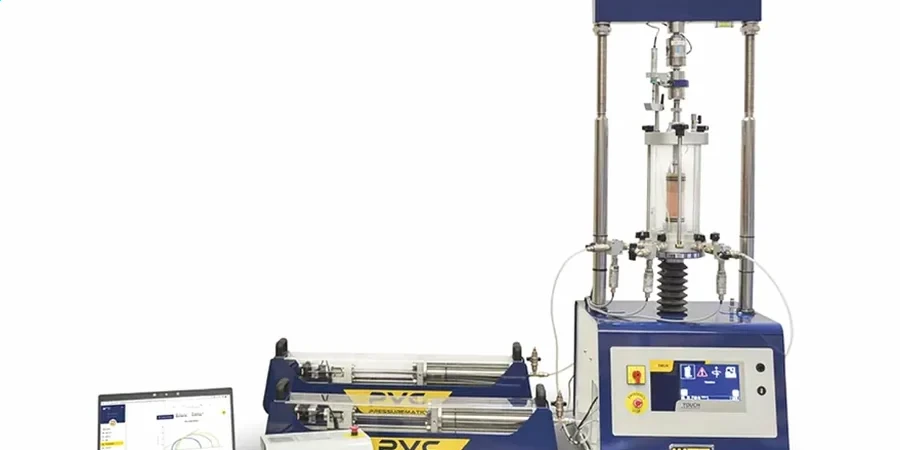
In our Milwaukee lab we consistently see that the natural moisture content of the local till sits right at the plastic limit, which makes sample preparation tricky. A poorly trimmed specimen loses suction and gives you a false cohesion reading. We run all three stages—saturation, consolidation, and shear—strictly following ASTM D4767 for consolidated-undrained (CU) tests with pore pressure measurement. For short-term analysis on silty clays under the Menomonee Valley fill, the unconsolidated-undrained (UU) test per ASTM D2850 gives the undrained shear strength (Su) fast. But the real value shows up on deep excavations where effective stress matters: the drained test (CD) defines the friction envelope for long-term stability. We have run side-by-side comparisons where the SPT drilling N-value suggested a friction angle of 32 degrees, but the triaxial on a high-quality sample gave 28 degrees—that difference changes the factor of safety on a 40-foot retaining wall. Our lab uses strain-controlled loading frames with electronic transducers, not old dial gauges, so you get clean stress-strain curves and pore pressure plots.
Advanced Triaxial Testing Milwaukee: Shear Strength & Soil Parameters
Technical reference image — Milwaukee

Local geotechnical context

The International Building Code (IBC) in Milwaukee requires foundation designs to consider the long-term drained strength of cohesive soils, and the City of Milwaukee supplement references ASCE 7 for load combinations. If you use only unconfined compression tests on fissured clay till, you will overestimate the shear strength by 20 to 40 percent. We have seen this in excavation failures along the Milwaukee River bluffs, where the soil looked competent in Shelby tubes but the triaxial CU test revealed a friction angle close to the residual value. The risk is not just wall movement; it is a base heave failure in a deep cut or a slope creep that cracks utilities 30 feet back from the crest. Getting the effective stress parameters early—before the shoring design is locked—saves months of rework and keeps the site safe during Milwaukee winters when frost adds surcharge to the cut face.

Need a geotechnical assessment?

Reply within 24h.

Email: contact@geotechnicalengineering1.org

Technical parameters

ParameterTypical value
Test types offeredUU, CU, CD per ASTM D4767/D2850
Sample diameter1.4 in to 2.8 in (35 mm to 71 mm)
Confining pressure range5 psi to 150 psi (typical for 0-100 ft depth)
Shear rate (CU/CD)0.001 in/min to 0.05 in/min based on consolidation
Pore pressure measurementElectronic transducer at base pedestal
Back pressure saturationUp to 90 psi with B-value check >0.95
Failure criterion reportedPeak and residual strength with Mohr-Coulomb envelopes

Other technical services

01

Undisturbed sampling and lab triaxial

We coordinate with drilling crews to extract Shelby tubes from Milwaukee's layered till, then run CU triaxial tests to define the Mohr-Coulomb envelope for deep foundation design. The report includes stress-strain curves, p-q diagrams, and design parameters ready for PLAXIS or manual calculations.

02

Triaxial suite for slope stability analysis

For bluff stabilization or riverbank protection along the Milwaukee River, we run a combination of CU and drained tests at multiple confining pressures to capture the non-linear failure envelope. This data feeds directly into limit equilibrium models and gives the geotechnical engineer confidence in the factor of safety.

Relevant standards

ASTM D4767 - Standard Test Method for Consolidated Undrained Triaxial Compression Test for Cohesive Soils, ASTM D2850 - Standard Test Method for Unconsolidated-Undrained Triaxial Compression Test on Cohesive Soils, ASTM D7181 - Standard Test Method for Consolidated Drained Triaxial Compression Test for Soils, IBC Chapter 18 - Soils and Foundations, ASCE 7 - Minimum Design Loads for Buildings and Other Structures

Quick answers

How much does a triaxial test program cost for a Milwaukee project?

A standard triaxial suite—including UU on three specimens and CU with pore pressure measurement on three specimens—runs between US$1,660 and US$2,670 depending on sample quality, confining stress levels, and reporting requirements. We provide a firm quote after reviewing the boring logs and project specifications.

What is the difference between UU and CU triaxial tests?

The UU test (unconsolidated-undrained) runs without allowing drainage during consolidation or shear, giving the undrained shear strength (Su) for short-term loading conditions like footing bearing capacity on low-permeability clay. The CU test (consolidated-undrained) consolidates the sample under a confining pressure and then shears it undrained while measuring pore water pressure, which yields effective stress parameters (c' and φ') for long-term analysis.

Can you run triaxial tests on Milwaukee's glacial till?

Yes. Milwaukee County's glacial till contains gravel and cobbles that require careful specimen preparation, but we routinely test the finer matrix using 2.8-inch diameter specimens. We trim the sample in a humidity-controlled room and use a membrane thickness rated for angular particles. The results correlate well with in-situ pressuremeter tests we have run on similar till units across southeastern Wisconsin.
Location and service area

We serve projects in Milwaukee and surrounding areas.

View larger map